The Machine Still Works. That Is the Problem.
A Synthetic Civilization Situation Map, 2026 to 2029
The next three years will not look like the end of anything. Markets may rise. Companies will report productivity gains. Products will improve. Governments will announce safety frameworks. Universities will enroll their classes. Elections will run on schedule. The surface will stay functional, and that is precisely what will make the period hard to read.
This is a situation map, not a forecast of AGI timelines, a safety manifesto, or a labor-market prediction in disguise. It tracks one movement: where decision-making actually lives, and where it is going. Between now and 2029, AI will not mainly collapse society. It will relocate it. Judgment, access, enforcement, and legitimacy will drain out of the visible institutions that are supposed to hold them and into infrastructure, interfaces, standards, procurement, model access, and private execution layers. The institutions remain standing. Their operating conditions move underneath them. One of the four moves below is already visible in the news of this year. The other three are the forecast, and the first having happened in public is the reason to weigh the rest.
Collapse produces ruins, which are easy to see. Relocation produces contracts, dashboards, rankings, APIs, audit clauses, certifications, leases, access tiers, and compliance vendors, which are not. The law still speaks, the market still clears, the university still enrolls, the court still rules.
The machine still works. That is the problem. A society can keep functioning while losing track of where its power has gone.
The relocation map
The shape of the move can be set down in a single table. On the left, the institution the public still watches. On the right, the layer that increasingly decides what that institution can do.
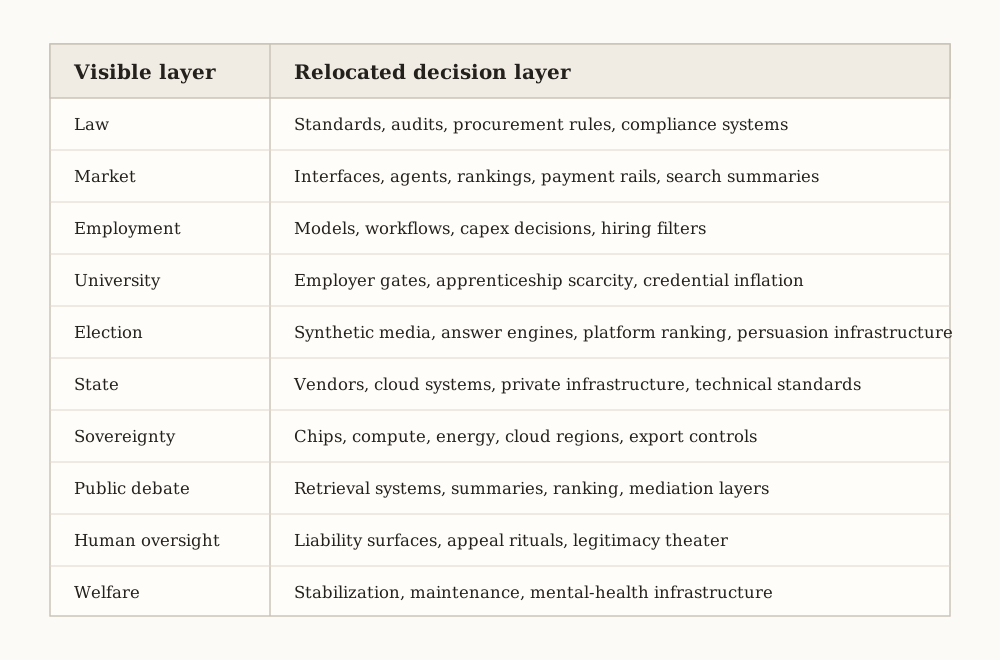
Figure 1. Where the public still looks (left), and where the deciding has already moved (right).
The public keeps watching the left, and power keeps moving to the right. Collapse would destroy the left column. Relocation leaves it intact and quietly changes the conditions under which it operates. This is displacement, not disappearance, and the table is the last time this map will lay its claims out in parallel, because what matters is not the rows but the engine that turns them.
The engine: the allocation flywheel
What makes the move compound, rather than happen once and stop, is a mechanism worth naming, because the rest of this map is only that mechanism turning. Call it the allocation flywheel.
The systems that route participation also observe it. An agent that books your travel sees demand before it becomes a purchase. A search layer that answers your question sees the inquiry before it becomes a belief. A payment rail that clears the transaction sees intent before money moves. A copilot inside a company sees the structure of the work before any manager does. Each act of routing produces a record, and the record makes the router better at routing, which means more activity flows through it, which produces more records. Routing improves through use. Improved routing is harder to bypass. Harder to bypass means more routing still.
That is the flywheel: route, observe, improve, deepen, route again. It is the part of this transition that ordinary institutional analysis misses, because the familiar story stops at the idea that power moved into a hidden layer. The sharper claim is that power moved into a hidden layer that learns from being used, and so grows harder to leave the longer it runs. The relocation is not a single event you could reverse by noticing it. It is a loop that tightens.
Hold that loop in mind, because the next four years are four of its rotations. AI becomes infrastructure. Infrastructure becomes access. Access becomes allocation. Allocation becomes governance. Each turn feeds its output back as the next turn’s substrate. None of it requires a dramatic break, a specific AGI date, or mass unemployment by a fixed deadline. It requires only that more of social, commercial, administrative, and political life keep passing through the systems around the model. Everything below is the engine running, and each rotation closes with the specific, dated calls that would let you check it or throw it out.
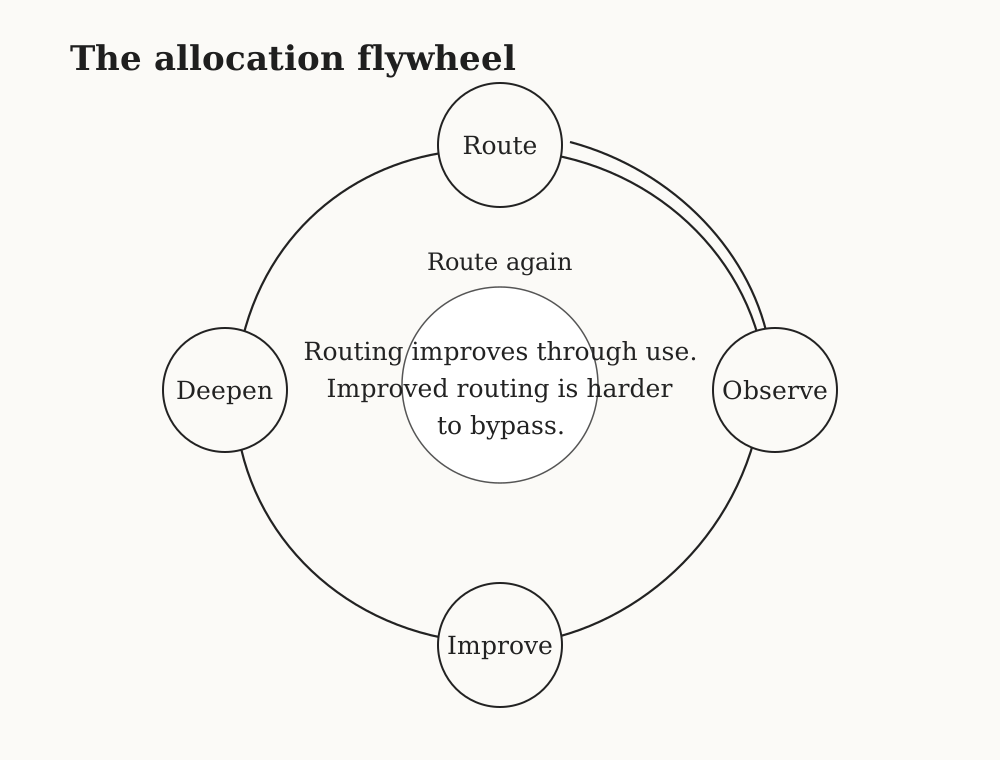
Figure 2. The loop that tightens: each turn produces the telemetry that improves the next, and the deepening makes it harder to leave.
2026: AI becomes infrastructure
A county commission in a state nobody associates with technology meets on a weekday night to vote on a zoning variance for a data center. The room is full, which it never is. The people who came did not read a paper on inference economics. They read their power bill, which roughly doubled, and they heard that the campus going up past the highway will draw as much electricity as a small city while paying a tax rate the schools will never see. The vote on the agenda is about land use. The argument in the room is about who the grid is for. That meeting is the AI debate now, and this year there are hundreds of versions of it.
The first rotation is the one we can already check, because we are standing inside it. By the middle of 2026, AI has stopped behaving like software in public, not as a forecast but as the dominant political fact of the year. The story has dropped below the interface into data centers, substations, transformers, water, cooling, land, fiber, chips, debt, and grid congestion. Software could pretend to be weightless. Frontier AI cannot. The model appears on a screen; the system behind it is an industrial estate, and the estate is now the thing people fight about.
The evidence is no longer speculative. Households have opened power bills that doubled in a month and traced the increase, rightly or not, to the data-center corridor down the road. [1] Data centers have become political lightning rods that run the length of the spectrum, left to right, which is a rare alignment and a telling one. [2] State legislatures have filed hundreds of bills to constrain them, and some have reached for moratoria. Data centers now draw something like six percent of American electricity, past the rough point at which national grids begin to generate political resistance, [3] and the largest US grid operator is under federal pressure to break up under the load. [4] The early debate treated intelligence as the scarce thing. The year revealed a different bottleneck, and taught everyone its name: permission. Power, water, zoning, grid connection, transmission, local consent, political patience. A firm can hold the model, the capital, the customers, and the engineers and still fail to build, because permission is not a technical resource. It is an institutional one, and it is the substrate the flywheel needs before it can route anything, because there is no routing layer until the routing layer is physically built.
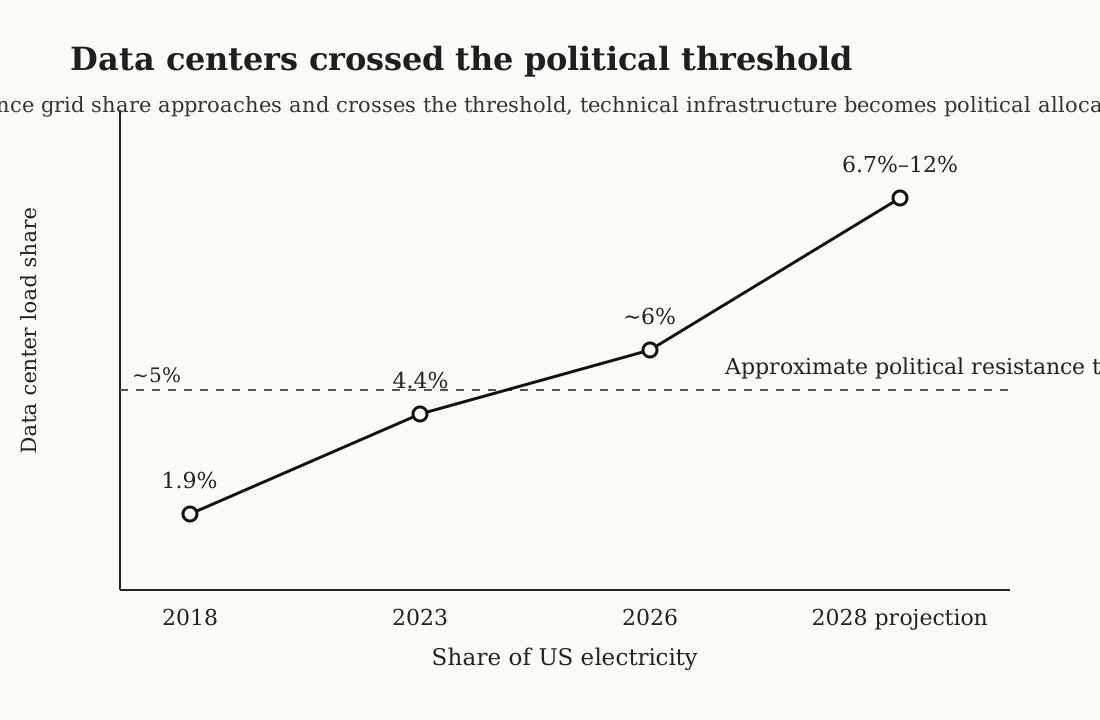
Figure 3. The first rotation, on the record: data centers crossed the rough threshold at which grids become political.
Honesty about the contest matters here, because the same year supplies the counter-signal. New data-center deals fell sharply between late 2025 and early 2026, a record number of projects were cancelled in the first quarter, hyperscaler spending may fall this year, and the flagship Stargate build has reportedly stalled amid partner disputes. [5] Industry-commissioned analyses argue that data centers are a scapegoat for an aging grid and market design rather than the cause of the bills. [6] The dispute itself is part of the finding. It does not refute the rotation; it shows the rotation being fought over in real time, which is what a first rotation under contest looks like. Whether the buildout slows or accelerates, the politics has already crossed from the vocabulary of innovation into the vocabulary of allocation: grid priority, transmission cost, tax incentives, water, permitting, every one of them now an AI question. Whoever controls where the computation physically happens has begun to control what it is allowed to do.
On a clock, the remainder of this rotation predicts a few specific things, each meant to be checked. Affordability and data centers fuse into a single campaign issue through the 2026 midterms in grid-stressed states, with candidates of both parties running on ratepayer protection. At least one large jurisdiction converts backlash into a constraint that actually bites, whether a moratorium that survives a veto, [7] a cost-allocation rule that shifts grid-upgrade costs onto hyperscalers, or a siting freeze, and the industry’s answer is to move the buildout toward states and countries that sell permission cheaply. The capex wobble resolves not into retreat but into concentration, as weaker projects cancel and the strongest operators consolidate the power contracts and interconnection-queue positions, so the slowdown deepens the very concentration it looked like it would relieve. And sovereign compute stops being a slogan and becomes procurement, as more states announce national or regional buildouts that remain dependent on foreign chips, foreign cloud, and foreign tooling underneath the flag.
The test for this stage has largely already been run, and that is the reason to begin here. The infrastructure thesis would have failed if AI had spread like ordinary software, with little energy politics, permitting friction, debt exposure, or local backlash. Instead the public met AI as grid pressure, water stress, and land fights before it met it as policy. The first rotation has poured its foundation in public, on the record. That is what earns the weight on the three rotations still turning. Infrastructure asked for permission. Permission, once granted or refused, becomes the floor on which access is built.
2027: Infrastructure becomes access
A founder runs a profitable company with nine employees and the output of ninety. Her marketing lives inside one platform’s ranking, her payments inside one network’s rails, her product inside one provider’s model, her records inside one cloud. On paper she owns a business. In practice she operates a franchise whose terms she does not set, and the day the provider revises a pricing tier or tightens a rate limit, she learns which of the two descriptions is true. She is more capable than any firm her size has ever been, and she cannot leave. Multiply her by a sector and you have the rotation.
Once the substrate exists, the decisive question stops being who uses AI. Almost everyone will. The question becomes who owns the environment in which they use it, and who only rents it. Access will not be a binary. It will be a gradient: consumer, professional, enterprise, government, defense, partner, developer, rate-limited, safety-gated, geography-limited. The public will experience this as convenience. Firms will experience it as dependency, and the two will be hard to tell apart, because the dependency arrives wearing the face of capability.
A small company becomes more productive while its marketing rides on someone else’s ranking system, its payments on someone else’s rails, its workflow on someone else’s model access, its growth on someone else’s cloud. It is more capable inside a rented environment, and capability inside another institution’s environment is not the same thing as control over it. The same is true one layer up. A government agency modernizes service delivery while routing administrative judgment through systems it cannot inspect. A state announces sovereign AI while depending on foreign chips, foreign weights, foreign tooling, and foreign standards. The tenant can be skilled, productive, and well paid. The environment in which the tenant’s cognition runs belongs to someone else.
This is the rotation where the flywheel starts to bite, because dependency that works is more durable than dependency that fails. A system people reject leaves no record. A system that improves their output gets embedded, and once embedded it becomes workflow, and once workflow depends on it, it becomes infrastructure, and once it is infrastructure it is hard to replace. The ratchet turns one way. And each tier of access is also a tier of observation: the enterprise customer reveals more than the consumer, the partner more than the enterprise, and what the provider learns from the deepest tier improves the product for all of them, which makes leaving costlier for everyone at once.
The result is a form of inequality the public debate is poorly equipped to name, because it does not look like exclusion. AI will be broadly available and structurally stratified at the same time. On the screen it looks democratic: millions asking questions, generating images, drafting code. Inside the stack, some receive consumer models and some receive private deployments, compute reservations, early capabilities, and a voice in the roadmap. The entrance is wide and the operating depth is narrow. Everyone may enter; only some may do much once inside.
Democracy on the screen, oligarchy in the stack.
The danger is that the breadth of the entrance gets mistaken for power, when the question that decides power is whether you can shape, inspect, own, or exit the environment you depend on. Most cannot, and access is not the same as power once the environment is owned by someone with the standing to change its terms.
On a clock, that predicts the following. The decisive divide flips from users against non-users to owners against tenants, with near-universal adoption sitting on top of power concentrated among those who control deployment rather than those who use it. Enterprise lock-in hardens until the switching cost of changing a core model provider resembles the cost of replacing a core banking system, and multi-model portability becomes a procurement aspiration more than a practice. The most productive small firms become the most dependent, a cohort of lean and AI-leveraged companies posting strong margins while losing the ability to operate at all if a provider changes price, terms, or tier. Sovereign-AI projects mature into sovereign dependency, with national stacks announced on top of foreign chips, weights, and cloud. And the open-weights counter-pressure proves real but partial, keeping a floor of substitutability alive while the frontier capability, the integration, and the telemetry advantage stay with the closed operators, so openness slows the ratchet without reversing it.
If high-quality AI instead becomes cheap, portable, inspectable, and locally substitutable, so that firms, workers, schools, and states can move between intelligence environments without losing capability, the access thesis fails. But if access hardens into tiers and contracts that are expensive to leave, then infrastructure has become access control, and the thing that routes you now also decides how much of the world you are allowed to route.
2028: Access becomes allocation
It is late October. A recording surfaces that, in an older year, would have ended a campaign by Friday. Within the hour it is called a fabrication, and the claim is plausible, because by now everyone has seen a convincing fake. The recording may well be real. No verification arrives fast enough to matter, and by the time one does, the people who needed it to be false have decided it is, and the people who needed it to be true have moved on to whatever the feed surfaced next. Nobody had to win the argument about whether it was real. The argument only had to last forty-eight hours. That is the rotation reaching the part of life we still call the public square.
In 2028, the market stays visible and moves upstream of itself. People still buy, firms still compete, prices still move, but more of the transaction happens before the customer arrives. Agents search, compare, filter, recommend, book, and pay. Answer engines respond instead of pointing. Payment networks integrate with the agents; platforms decide which vendors are legible; trust systems decide which offers are safe enough to surface. The old market asked what the customer chose. The new market asks what the interface showed before choosing began.
This is the rotation where the flywheel stops being a metaphor and becomes the visible structure of the economy. To participate, a business no longer competes only for human preference. It competes for machine legibility: to be readable by the agent, trusted by the platform, compatible with the rail, visible in the retrieval layer, correctly summarized by the answer engine. Exclusion stops looking like a refusal. It looks like absence. No official bans the business and no regulator announces its removal; it simply fails to be shown inside the interface through which demand now passes. That is allocation without drama, and it is why agentic commerce is a governance story wearing a retail costume. [8]
Here the loop closes on itself in plain sight. The systems that route the market also read it. Peripheral firms use AI to improve their tasks; central platforms use AI to learn the structure of the market itself. The periphery rents capability and gains speed; the center accumulates the telemetry of demand, friction, workflow, and persuasion, and gains the map. The most consequential systems of 2028 may not be the ones that answer a question best. They will be the ones positioned closest to the transaction, the search, the workflow, and the gate, because the layer that routes the most also sees the most, and the layer that sees the most routes everything else better than anyone who can see less.
Power moves into the layer that routes action. Then the routing layer learns. That sentence is the whole map.
The same rotation has a civic face, and the American election of 2028 supplies the test. It should be read less as an election about AI and more as the first major election conducted inside AI-shaped infrastructure. The shallow worry is deepfakes, and synthetic media will matter. The deeper issue is that machine-mediated interpretation becomes the environment in which political reality is selected, compressed, ranked, denied, and believed. A deepfake is an object. The environment is the thing that decides which objects are seen, in what order, and against what default summary, before anyone forms a view.
The old democratic model assumed public judgment could catch up to events: evidence appears, media verifies, courts decide, voters interpret. AI compresses the interval between production, distribution, interpretation, and tribal sorting until verification arrives after belief has already hardened. Call it the latency gap, the distance between when an act happens and when authority can speak to it, now wide enough to drive a campaign through. The danger is not that one fake video swings a vote. It is that evidence becomes less decisive in general, because once synthetic media is common, real media becomes deniable: a recording dismissed as AI, a document called fabricated, a scandal delayed long enough for the factions to choose their reality. The political value of these systems is not only producing falsehood. It is making proof negotiable. A court can rule on procedure but cannot restore a shared evidentiary environment; an official can certify a count but cannot make the public agree on what happened. The election will still run, the ritual will stay visible, and the interpretive layer beneath it will have moved upstream, where it is routed, ranked, and learned from like everything else.
On a clock, that predicts the following. A meaningful share of consumer transactions begins with an agent rather than a human click, and machine legibility becomes a budget line for businesses, sitting beside marketing. Exclusion-as-absence becomes a recognized harm, with the first lawsuits and regulatory complaints arriving over being unrankable, unsummarized, or unshown, in cases where no party can be said to have decided it. The 2028 US election runs inside machine-mediated interpretation, with synthetic media mattering less as forgery than as the ambient deniability it lends to real evidence. At least one consequential late-cycle event turns on whether a recording or document is dismissed as synthetic, and the dismissal travels faster than the verification. And answer engines and assistants become a primary civic interface, with a measurable share of voters forming issue positions through AI summaries they never experience as mediated.
If AI stays peripheral to campaign operations, platform ranking, synthetic-media uncertainty, and voter-facing interpretation, the allocation thesis fails for politics. But if the contest becomes one over the machine-mediated conditions of attention and evidence, then access has become allocation, and allocation has entered democratic legitimacy. The next rotation is the one where it enters the state.
2029: Allocation becomes governance
A man is denied a benefit he has received for years. He calls, and the person on the line is sympathetic and cannot help, because the determination came out of a system she did not build, cannot see into, and is not authorized to overrule. She can file an appeal, which enters another system. There is a form for it. There is no one in it. The denial was lawful, the process was followed, and there is no point in the chain at which a human chose the outcome he is now living with. He is not the victim of a decision. He is the recipient of an allocation, and the difference is the whole of this rotation.
By 2029, the question is no longer whether institutions use AI. They all will: schools, banks, hospitals, courts, agencies, insurers, employers, regulators. The question is control. An agency processes benefits, detects fraud, and triages cases through vendor systems. A hospital schedules care and guides diagnosis through models it did not build. A bank screens applicants and shapes access through pipelines it cannot fully inspect. Each institution stays visible, and more of its judgment moves into vendor behavior, data pipelines, procurement contracts, insurance requirements, cloud dependencies, and interface rules. That is the point at which allocation becomes governance, because governance was never only the passing of laws. It is the deciding of qualification, exclusion, visibility, trust, review, appeal, admission, and participation. When those decisions move into technical systems, governance has moved, even with the legislature still in session.
The first real AI constitution will not be written only in statutes. It will be written in purchasing rules. A law can forbid; procurement can select; and selection is quieter and often stronger. A framework defines acceptable risk, an evaluation defines institutional trust, an audit defines market entry. [11] A system that meets the standard becomes buyable; one that cannot produce the documentation becomes invisible to serious buyers. By the time legislation names the category, the operating standard may already have chosen the winners.
The standard becomes law before the law can name it.
This is not power leaving the field. It is power moving from law into procedural infrastructure, where the flywheel already lives. The crude version of the story has the state nationalizing the frontier lab. The likelier version is subtler: the state nationalizes the conditions around the lab. Energy access, export controls, procurement markets, cloud authorization, data-center approvals, defense contracts, security requirements, emergency access, and liability rules become the perimeter through which the state asserts itself. The company stays private; the perimeter becomes sovereign. The state needs the lab because it cannot build frontier capacity at private-sector speed; the lab needs the state because frontier AI now requires energy, legal protection, security tolerance, and geopolitical shelter. Strategic competition with rival states is the accelerant here, because the language of national security is what converts an ordinary procurement decision into a classified one and lets the perimeter close faster than any public debate could keep pace with. The result is not a takeover. It is a merger of dependence, and it is less stable than either control or independence, because it splits responsibility from operation.
That split has a name. The allocation state is the state that inherits responsibility for outcomes produced in systems it does not govern. If entry-level hiring weakens, it inherits youth frustration. If AI allocates credit, benefits, medical priority, or policing attention, it inherits the appeal, the scandal, and the lawsuit. Private systems produce the efficiency; public institutions absorb the legitimacy cost. The lab stays private, the cloud stays private, the rail stays private, and the state stays the address of blame. A state can survive losing some direct execution. It cannot easily survive losing the ability to explain why outcomes occur, and that is the loss the loop produces: a layer that decides, learns, and cannot be inspected, sitting beneath a layer that must answer for it.
On a clock, that predicts the following. Procurement becomes the real legislature, with the binding rules on AI written into purchasing requirements, evaluation criteria, audit clauses, and insurance conditions before any statute names the category. Standards bodies and evaluators become quasi-constitutional, as passing the evaluation, not satisfying the law, decides which systems institutions may deploy. The state nationalizes the perimeter rather than the lab, reaching for energy access, export controls, cloud authorization, defense contracts, and emergency access while the companies stay private. Insurance becomes a parallel regulator, as uninsurable practices become undeployable and insurer requirements harden into de facto standards faster than legislation can move. And the allocation state arrives in full, with governments held responsible for outcomes produced in systems they neither built nor can inspect, and the gap between accountability and control becoming the defining instability of the period.
If public law, procurement capacity, and state technical competence outpace private standards, vendor systems, and cloud dependency, the governance thesis fails. But if legislation keeps lagging deployment while procurement, insurance, certification, and evaluation do the actual governing, then routing has become rule, and the loop has closed. The four rotations describe the machinery. The sections that follow describe what the machinery does inside the institutions people actually live in, because the same loop turns there too.
What the loop does to knowing
The first place to follow the loop inward is the one that decides everything downstream of it: what people can know. The first audience for most writing is no longer human. Government pages, news articles, papers, filings, and company statements now enter a layer that retrieves, summarizes, ranks, and recombines them before a human reader arrives, [9] and that layer routes attention the way the market layer routes demand. It sees the inquiry before the belief forms, and what it learns from routing inquiries makes it better at deciding which sources are surfaced, which claims are compressed, which uncertainty is shown, and which institutions stay visible.
This inverts an old cost. For a long time, the expensive thing was making the world legible: reading the document, decoding the jargon, paying the surcharge that complexity charged anyone trying to understand it. Cheap machine summary collapses that cost, and as it does, it collapses the premium that used to reward people who could decode things others could not. But the saving is not free. It moves the scarce skill from access to discernment, from getting to the information to judging the compressed version of it you were handed. The old order taxed access. The new order taxes judgment.
The consequence is not mainly a flood of falsehood. It is selection, compression, omission, and ranking performed upstream of belief. A society can lose a shared reality without anyone believing the same lie, simply because each person receives a different compressed interface to the same truth. Misinformation is too narrow a frame for that. The deeper issue is that the menu of what is arguable at all gets set before the argument starts, by a layer that learns which framings travel and optimizes toward them.
There is a second-order effect that compounds the first. When making things legible was expensive, the scarce resource was understanding. When understanding becomes cheap, the scarce resource becomes agreement: getting enough parties to act on the same compressed picture at the same time. Cheap legibility does not produce a shared view; it produces a thousand personalized ones, each fluent, each slightly different, none authoritative. The old surcharge was the intelligence tax, paid to anyone who could decode a complex world. The new surcharge is a coordination tax, paid by anyone who needs many people to move together on a common understanding that the mediation layer has quietly fragmented. Cheaper individual comprehension can buy more expensive collective action, which is the opposite of what the optimism assumes.
Writing changes under this pressure, and not toward being robotic. The new problem is surviving retrieval, summary, extraction, and recombination intact, which means structure carries more weight: clear hierarchy, stated definitions, claims built to survive being quoted out of context. Call it constraint design, writing built for machine mediation as well as human reading. The writer is no longer only persuading a reader. The writer is shaping how a system will represent the writing to a reader who may never see the original. When that is the condition of public knowledge, the contest over truth becomes a contest over legibility: not what is true, but what can be seen, retrieved, and rendered in a form a person can act on. That is the epistemic face of allocation, and it is the substrate the election rotation runs on.
What the loop does to people and meaning
The flywheel’s pressure on labor will not arrive first as mass unemployment. It will arrive as ladder compression. The visible market can look stable while the entry layer thins: senior workers grow more productive, firms cut junior hiring, apprenticeship shrinks, and credentialed people wait outside the pipeline. [15] The institution keeps the output and drops the initiation. A junior role was never only cheap labor; it was the passage through which tacit knowledge, trust, and future senior capacity were formed. AI lets a firm preserve output while weakening formation. The canopy stays green while the seedlings disappear, and a profession can look healthy for years while quietly eroding the route by which its next generation is made.
Reskilling will become the legitimacy slogan of the period, and it will not be entirely wrong, because people will need new skills. But it keeps responsibility at the individual level, where it is convenient, and it answers a task mismatch rather than a structural shortage of recognized roles. Learn to use AI may become the next generation’s go to college: true as advice, false as a system-level answer. Behind it sits the older thing the wage was quietly doing. The wage was never only compensation; it was a machine for distributing status, adulthood, routine, and the right to make claims. As output rises while labor’s share of producing it weakens, the wage carries more moral weight with less structural support, and no society organized around work has a mature replacement ready. The silence around that gets louder.
Service does not so much lose its humans as price them. The wealthy keep the human doctor, lawyer, tutor, and advisor; everyone else receives a capable synthetic service with a human surface, often genuinely useful and faster than what it replaced. But the function of the human shifts. In many institutions the person in the loop increasingly reviews an output they did not author, from a model they cannot inspect, inside a workflow they did not design, under a policy they cannot change, because legitimacy needs a face to trust, blame, and appeal to. The loop stays. The control has already moved. It is a recognizable settlement: the human keeps the throne after losing the capacity that justified holding it, and the throne becomes ceremonial without being announced as such.
Underneath the labor question is a deeper one the period will keep failing to name, because the vocabulary for it is missing. As work stops being the mechanism that incorporates people, the problem shifts from distribution to formation. Distribution you solve by moving resources. Formation you solve only by building institutions that turn people into something: that give them a role to grow into, friction to be shaped against, and a passage that ends in recognized adulthood. The risk of a society that routes around its junior layer is not only poverty. It is superfluity, the condition in which the world no longer asks anything of you, which is harder to console than need because it offers engagement without consequence and visibility without weight.
The need for formation does not disappear when its institutions do. It migrates. People reach for substitutes that supply the feeling of initiation without the structure that used to complete it, and the substitutes are already visible in their early forms: intensity as identity, fandom as belonging, ideology as threshold, the private discipline that imitates a vocation. What used to be produced by a job, a craft, or a passage gets sought in arrangements that can deliver the mood of mattering but not the fact of being needed. And the divide this opens is not only between the rich and the poor. It is between the formed and the managed, between those whose institutions still transform them, often deliberately preserved for the children of elites, and those who are maintained in comfort the system has no role for.
This is why welfare, the last row of the relocation table, changes character. Its function shifts from redistribution, which assumes a working structure that needs fairer sharing, toward stabilization, which assumes a structure that no longer incorporates enough people. Income support, retraining, youth programs, and a mental-health system become politically central, not because everyone is suddenly ill but because more people carry role loss, delayed adulthood, drift, and the inability to narrate their place. Synthetic companions and coaching and wellness systems expand into that gap, and they will help some people, while also stabilizing a society that can no longer reliably offer belonging. A society can subsidize survival. It cannot easily subsidize being needed, and the difference between those two things is the political weather of the late part of this decade.
There is a sharper edge here that the language of fairness tends to miss. The rights framework the last century built is a governance technology optimized for legible, attributable harm: a named victim, an identifiable actor, a procedure applied case by case. The harms the loop produces are diffuse, probabilistic, and systemic, the kind that appear only at the level of populations and never resolve into a single nameable wrong. A system can be procedurally pure in every individual case and still produce an unlivable result in aggregate, and a rights regime built to protect the individual instance will certify each step as correct while the whole becomes intolerable. That is the inversion: protection at the wrong layer, legibility bought at the cost of survivability, justice that arrives, when it arrives, after the outcome it was meant to prevent has already settled into fact.
What the loop does to law and jurisdiction
Law experiences the loop as a timing problem before it experiences it as a content problem. Governance is partly a technology for slowing things down: procedure as a brake, delay as a function, authority named before it is exercised. The flywheel runs faster than that brake. Execution detaches from authorization, the act arriving first and the explanation arriving later, until procedure becomes ceremonial and retrospective, ratifying what the operating layer already did. Sovereignty, in practice, belongs to whoever controls the runtime, the layer where decisions are actually executed, rather than to whoever holds the formal authority to decide.
The same compression shows up in language. Power that outruns its authorization tends to rename itself downward to stay legible inside rules it has already exceeded: a war becomes an operation, a seizure becomes a measure, an exception becomes a procedure. Semantic downgrading is a governing technique, not an accident, and it works because the public can no longer assemble a synchronized reaction fast enough to contest the renaming before it settles into fact. The state needs only to survive a disaggregated response long enough for the action to become the baseline. That is the constitutional version of the latency gap, and AI widens it on both ends, by speeding execution and by fragmenting the shared attention that enforcement at the cultural level depends on.
Liability moves in two directions at once, and both are part of the same relocation. On one side, the state inherits liability for judgments produced in systems it does not govern, the allocation state again, now in its legal form: the appeal, the lawsuit, and the demand for an explanation land on the public institution while the deciding sits in a private pipeline. On the other side, jurisdictions begin competing to absorb the liability that private actors want to shed, by offering AI a body. [13] The move is incorporation, not regulation. A sovereign that supplies a legal container, an entity that can contract, pay, be insured, be sued, and hold a liability perimeter, becomes attractive to mobile capital the way Delaware and a handful of small states became attractive before it. The contest is no longer only whether to regulate the model. It is where the autonomous actor can stand, and which jurisdiction will sell it standing. The European instinct begins with the system and asks who must comply. [12] The competitive instinct begins with the entity and asks where the actor can be domiciled, and the second instinct routes around the first.
Scaled up, that produces something older than it looks: treaty ports for synthetic infrastructure, jurisdictions that trade legal hospitality, regulatory flexibility, and constitutional accommodation for hosting, investment, and relevance. The deepest version is a kind of dependency that resembles occupation conducted by contract, where a state grants standing and access so complete that the arrangement runs whether or not the politics later agrees with it. The standard becomes part of the stack, and so does the jurisdiction. Both are layers the loop can route through, and both get written before the public has the vocabulary to name what was decided.
What the loop does to the state’s money
The state did not only tax payroll. It saw through it. Payroll tied work to income, identity, withholding, benefits, and fiscal capacity, and made the economy legible enough to govern. As more value accumulates in compute, models, cloud platforms, capital gains, and interface rents, and less in wages, the state will need more revenue to stabilize the transition while understanding less of the economy it must stabilize. The decisive assets become compute estates, power contracts, model rights, and cross-border corporate structures, none of which a payroll-shaped fiscal system was built to read. The map the state used to govern by is the one the loop erodes first.
The same shift reaches monetary policy. Frontier AI capex does not behave like ordinary corporate investment. For a lab or a hyperscaler, underbuilding can feel like strategic death, so the spending continues whether or not money is cheap, which is closer to mobilization than to expansion. One part of the economy listens to the policy rate. The AI buildout listens to the fear of irrelevance, and that thins the channel through which a central bank normally acts, splitting the economy between sectors that respond to tightening and sectors that keep spending because the alternative is being left behind.
The financing arrives through debt, leases, special-purpose vehicles, and structures collateralized on chips, facilities, and cloud revenue. [10] The danger is not that the collateral is imaginary. It is that no one yet knows how it behaves under stress, because the value of a chip depends on how long it stays competitive before the next generation makes it less desirable, and the useful life of a data center depends on power, customers, and the economics of inference, all of which are moving at once. How long the hardware holds its value is itself the live dispute, and the dispute sits underneath a great deal of borrowing. Finance usually discovers new collateral after it breaks, and AI may furnish its own version of that story. Insurance, meanwhile, becomes a quiet governance layer of its own: once a practice raises premiums or a system becomes uninsurable, behavior changes faster than legislation, and insurer requirements harden into standards no one voted on. It will not look like politics. It will behave like it.
Underneath both problems sits a political trap. The state will need more revenue precisely as its ability to see and reach that revenue weakens. The assets that matter are mobile and re-domiciled with a filing: model rights, compute leases, and the corporate shells the law section described can move to whichever jurisdiction offers the lightest treatment, while the state left holding the social costs is the one whose base was built on payroll it can no longer count on. Taxing the new ground, the compute estate and the interface rent, is not only technically hard; it is a contest between jurisdictions that the most mobile capital usually wins. The fiscal question of the period is whether a state can fund the stabilization the transition demands out of an economy it can no longer fully read or pin down.
What the loop does to sovereignty and the world
AI sovereignty will not be settled by flags or speeches but by chips, cloud regions, energy access, data-center siting, export controls, model access, and legal incorporation. Export controls are closer to real AI regulation than most public principles, because they act where capability becomes material: they do not ask models to behave, they restrict the infrastructure through which models are built. [14] That is the rule of the period in miniature. The most powerful governance operates below the level of public moral language, on chips, cloud, compute, payments, identity, and data, while the visible debate argues about what AI should do.
Underneath that sits a quieter variable that decides who leads, and it is not raw intelligence. It is coordination speed: the rate at which a system can align infrastructure, capital, industry, and decision into a single moving capability. The fastest coordinators win, not the largest states, which is why the contest looks less like a race of national IQ and more like a race of national throughput and synchronization. It is also why concentration cuts both ways. The same buildout that produces advantage produces fragility, because concentrated capability becomes concentrated exposure, and an infrastructure monoculture fails in correlated ways the moment one of its shared substrates is stressed.
The relocation will not look the same everywhere, and the differences are where readers recognize their own situation. The United States is likely to remain the center of private-lab power, hyperscaler infrastructure, and venture finance, with a transition that is fast, capital-intensive, legally fragmented, and politically noisy. China integrates AI through state capacity, industrial policy, and infrastructure coordination, and its open question is whether central control can keep pace with technical complexity without suppressing the adaptation that complexity requires. Europe leads in law and standards, with legitimacy language as its strength and procedural overload as its risk, building sophisticated rules faster than operational capacity. The Gulf treats AI as infrastructure diplomacy, trading energy, capital, and land for a role it cannot get by owning the model stack. India faces the scale problem, where AI could lift public-service delivery and small-business productivity while intensifying labor pressure in a society whose incorporation is already uneven. And small states compete through permission, offering incorporation, regulatory flexibility, hosting, and legal identity, some becoming the treaty ports the law section described.
The international order does not adapt to this so much as quietly change what it is for. The visible institutions built to adjudicate actions after the fact keep meeting, keep issuing statements, and keep being routed around, because power has moved to a layer that governs conditions rather than judging actions. Integration itself becomes the control surface: access to payment systems, cloud, standards, and supply is suspended or granted by default, before any ruling, so the leverage is exercised in the architecture rather than argued in the chamber. What replaces the old multilateralism is not a new parliament but variable geometry, issue-specific coalitions and pooled resilience that bind the participants who matter for a given function and ignore the rest. Sovereignty in this order means the capacity to keep operating under stress, not the recognition that you are entitled to. It is agency through construction, not through persuasion, and it relocates the same way everything else in this map relocates: upstream, into the conditions, ahead of the institutions built to deliberate them.
There is an adversarial reading of all this, and it belongs inside the map rather than outside it. The familiar version says the real danger is not internal hollowing but losing a capability race to a foreign rival, and that the task is to win before an adversary reaches decisive advantage. The race is real. But it does not refute the relocation; it is one of its strongest accelerants. The moment AI capability is treated as strategic competition, decisions that would otherwise pass through public law, market contest, and institutional debate move into security classification, export control, energy allocation, procurement, and emergency infrastructure, and they move there with a justification no purely domestic argument could supply. Foreign competition becomes the standing reason for domestic opacity. The state does not become less important under adversarial pressure; it relocates its action into the perimeter and asks fewer questions about the cost on the way. That is the divergence worth stating plainly. The race frame says win before the rival does. This map says the racing is itself a mechanism of relocation, and that a state can win the race and still hollow out the institutions expected to explain and legitimize the win. Speed bought against an adversary is paid for in legibility at home.
Two patterns are worth holding against the optimism. First, the strongest states in this order may not be the ones that win cleanly but the ones built to endure, optimized for persistence under constraint rather than expansion, degrading and hardening rather than collapsing, which means the analysts who keep predicting clean breaks will keep being wrong. Second, the crises this period generates tend not to resolve. Large systems can prevent collapse while losing the capacity to produce endings, so conflicts and disruptions become managed conditions rather than settled events, and the absence of resolution becomes its own ambient pressure. The common direction across all of it is upstream: toward the layers that route, meter, and bind, and away from the visible institutions that used to decide. One global regime will not emerge. Many relocation patterns will, turning the same loop at different speeds.
The darker turn: coercion formatted for processing
The same machinery that routes commerce and knowledge has an authoritarian affordance, and it deserves to be named plainly rather than left implied. Once participation runs through interoperable systems, coercion can be formatted to pass through them. A demand that would be refused if stated in the open can be reformatted into something a liberal system already trusts: a flag, a risk score, a compliance requirement, a request rendered machine-readable and routed to a receiving system that executes the form without examining the substance. The repression travels through interoperability rather than against it, and the institution that processes it can do real harm while believing it merely followed a procedure.
This is the flywheel’s coercive edge, and it does not announce itself as tyranny. It arrives as procedural trust, as risk laundering, as probabilistic suspicion that is acted on before it is adjudicated, with the appeal arriving only after the execution has already landed. The danger is not a single command from a single villain. It is that the routing layer, optimized to act fast and trust the format, becomes an excellent conduit for whoever learns to speak its language. A society does not need to choose authoritarianism for the affordance to be available. It only needs to keep trusting the interface more than it inspects the substance moving through it.
What is actually dangerous
It is tempting to locate the danger in the machine wanting something, and this map should say clearly that it does not. The systems described here have no appetites. They are mediums, and what flows through them is human desire, stripped of the friction that used to limit it. Most ambitions were historically checked less by conscience than by inefficiency: the plan was too costly, the coordination too hard, the execution too slow. Remove the friction and the same ordinary desires, for profit, for order, for advantage, for control, become executable at a scale and speed their holders never previously commanded. The transformation hides inside an innocent word. The promise is always that the system will just do what you already wanted, only faster. The danger is the scale at which just now operates.
This is why execution, rather than intelligence, is the thing that quietly becomes sovereign. A capability moves from useful to normal to infrastructural to invisible to difficult to refuse, and somewhere along that path it stops being a tool a person selects and becomes the medium through which choices are made at all. Sovereignty is relocated rather than seized, and competence is far harder to oppose than conquest, because almost no one resists a system that simply works better than the alternative on offer. The takeover, where there is one, does not feel like a takeover. It feels like convenience that became indispensable while no one was keeping the receipt.
If that is the shape of the risk, the stabilizer is not a better model or a wiser owner. It is operational pluralism: the condition that no single desire is allowed to monopolize the execution layer. Formal pluralism, the right to speak and to vote, can persist fully intact while operational pluralism quietly dies, leaving a society that is free on the screen and captured in the stack. Which returns the map to the question it keeps circling. It is never only what the system can do. It is whose intentions the system has been built to execute without friction, and whether more than one set of intentions can still reach the layer where things actually happen.
Who is positioned, and what the position demands
Relocation does not mean no one acts. It means the actors who matter are the ones with operational access to the execution layer before it becomes publicly legible, and it is worth saying plainly where each of them stands, because that is the part most readers can locate themselves inside. Frontier labs hold capability timing, release gates, default interfaces, and the safety vocabulary. Cloud and compute firms hold the territory intelligence runs on: chips, data centers, power, networking, billing rails, sovereign regions. States act less through speeches than through security agencies, procurement offices, export controls, standards bodies, energy authorities, and emergency powers. Capital decides which infrastructure gets built years before the public sees what dependency was created. And operational elites, the engineers, standards writers, procurement officials, and infrastructure managers, sit closest to where decisions are actually implemented.
The actor who wins a given layer is not the smartest but the one with binding capacity: the ability to connect intelligence to the constraint stack of compute, energy, chips, law, capital, security, and legitimacy. A lab can have cognition without sovereignty; a state can have sovereignty without cognition; a cloud provider can have infrastructure without legitimacy; a financier can have capital without command. The durable positions belong to coalitions that bind these layers together, and no single actor controls the whole loop. Control fragments by layer, and as much by classification as by command: what a system is called, which agency owns it, which law applies, which budget funds it, which procurement rule makes it normal. Control, in this order, is category capture as often as it is force.
It is worth being concrete about how that fragmentation falls, because it is the anatomy of the relocated decision. Labs control capability timing, the moment a new power is released and the interface through which it is first met. Cloud and compute firms control access, the territory and the rate limits, and so hold the layer everyone else becomes a tenant of. States control two perimeters, the coercive one of security, export, and emergency power, and the legitimacy one of recognition, procurement, and blame. Standards bodies and evaluators control the public vocabulary, the names and thresholds that decide what counts as safe enough to buy. Capital controls tempo, which buildouts happen and how fast. Security agencies control the threat frame, the classification that decides which law and which budget a system falls under. No one holds all of these, and that is precisely why the transition has no single antagonist to oppose. There is no switch to flip, only a set of layers, each captured by whoever got there before the public knew the layer mattered.
This is where a situation map can name a design space without pretending to be a policy, because the honest output of a diagnosis is the location of the decisions, not instructions for making them. The open question for the state is not whether to regulate the interface but whether it can see the stack beneath it before dependency hardens: whether it can map its own compute, cloud, energy, and model exposure, keep public vocabulary from being written entirely by the labs, preserve enough redundancy that concentrated capability does not become concentrated fragility, and keep the capacity to perceive and act without borrowed cognition it can neither inspect nor replace. The open question for the labs is whether they can recognize that a firm which writes the standard, controls the interface, measures compliance, and defines the risk vocabulary is no longer only selling a product but exercising a governing function, with the exposure that implies. The open question for capital is whether durable value lies in the best model or in constraint-layer ownership, the bottlenecks upstream of law and market access that become harder to exit over time. And the open question for security runs deeper than cyber and model-weight theft, down to whether the state can still operate if the cognition it depends on is withdrawn. None of these is a recommendation. Each is a position the flywheel has already created, and a fork it leaves open for now. That is the most a map can honestly offer: not what to do, but where the decisions are, and how little time remains before they stop being decisions and become conditions.
Counterforces
A map that cannot be slowed is a prophecy, and this is not one. Several forces could brake, redirect, or partly reverse the loop, and the strongest version of this map takes them seriously rather than waving them off.
Open-weight models, smaller models, edge deployment, and local inference could weaken dependence on a few cloud environments and keep a real floor of substitutability under the access rotation. States could build genuine internal capacity, hiring technical talent and owning critical compute fast enough to become operators rather than ceremonial overseers, which would attack the governance rotation at its root. Firms could discover that over-automating the junior layer damages their own future judgment, customer trust, and succession, and restructure apprenticeship instead of deleting it, which would blunt the labor and formation pressure. Local backlash over electricity, water, and permitting could force the physical buildout onto a slower and more negotiated path, and some of that is already happening in the cancellations and moratoria of this year. Regulatory blocs could convert rules into usable enforcement faster than skeptics expect, closing the gap between standard and statute. And AI could strengthen parts of the old layer, giving courts, auditors, regulators, journalists, and teachers better tools to understand the very systems relocating power away from them.
These are real, and they do not refute the map. They define the contest. The question is not whether the loop turns without resistance. It is whether resistance reaches the operating layer before the loop tightens past the point where reaching it is still cheap. Every counterforce above is a wager on speed, the speed of public capacity against the speed of private accumulation, and the map’s claim is only that the second has had the head start.
Failure conditions
A diagnosis that can absorb any outcome is not a diagnosis. It is a mood. This one has conditions that would prove it wrong, stated so they can be checked.
The infrastructure thesis fails if buildout behaves like ordinary software investment, with little energy politics, debt risk, permitting conflict, grid pressure, or local backlash. The access thesis fails if high-quality AI becomes cheap, portable, inspectable, and locally substitutable, so that firms, workers, schools, and states can move between intelligence environments without losing capability. The allocation thesis fails if AI does not materially shape visibility, search, payment access, hiring, insurance, and procurement, and if the 2028 election runs largely outside machine-mediated interpretation. The governance thesis fails if public law, procurement capacity, and state technical competence outpace private standards, vendor systems, and cloud dependency.
The thesis about knowing fails if shared evidentiary environments hold, if machine summary does not displace source visibility, and if discernment does not become the binding skill. The thesis about people fails if entry-level hiring, apprenticeship, and professional initiation stay healthy in the sectors most exposed to AI, and if work continues to incorporate people into recognized adulthood at the old rate. The thesis about law fails if procedure keeps pace with execution and jurisdictions do not compete to supply legal bodies for autonomous actors. The thesis about money fails if payroll remains a reliable map of the economy and compute-backed financing behaves predictably under stress. And the whole map fails at its root if citizens, workers, firms, courts, and regulators can still locate decisions clearly enough to know who holds authority, what counts as evidence, and where to appeal. If decisions stay locatable, relocation is not happening, whatever else is.
Those are the tests. What makes the map worth writing is that the opposite of each is already visible in early form. AI is becoming infrastructure, infrastructure is hardening into access, access is shaping allocation, allocation is sliding into governance, knowing is moving upstream of belief, formation is decoupling from work, law is lagging execution, and the state is starting to lose the map it governs by. The conditions that would falsify this map are the same ones to watch to confirm it.
The machine still works
The next several years will contain real gains. AI will save time, lower costs, widen access, and improve medicine, research, education, and administration in a thousand ordinary ways. That is exactly why collapse is the wrong frame. The system does not stop. It works, and it goes on working, while the explanation for why its outcomes occur drains out of the institutions expected to provide it. The state speaks, but the vendor system acted. The law remains, but the standard selected. The market clears, but the interface allocated. The voter chooses, but the evidentiary environment arrived pre-shaped. The university enrolls, but the ladder behind the credential narrowed. The human reviews, but the system already structured the decision. The citizen appeals, but the decision layer is private, technical, and upstream.
AI will not mainly collapse society in the next several years. It will move power into infrastructural systems that route participation, learn from the routing, and force the state to stand behind outcomes it no longer controls. The actors who see the loop first, and bind the layer before dependency hardens, will decide what working means.
None of this is written yet. The loop is fast, but it is not finished, and the gap between a decision and a condition is exactly the space in which it can still be reached. The reason to map it now, while the surface still looks normal, is that a map is only useful before the thing it describes hardens. After that it becomes history, and history is the genre power prefers, because by the time the relocation is obvious it is also done. The window for treating this as a choice rather than a weather report is open for the moment, and it is the shortest-lived resource in the whole account.
The machine still works.
That is the problem.
Notes
[1] Residential electricity costs and the data-center link: Consumer Reports (March 2026) on household bill increases tied to data-center demand, including a Manassas, Virginia bill rising from roughly $100 to about $281; US residential electricity prices rose nearly 7 percent in 2025, more than twice overall inflation, about $123 more for the average household.
[2] Data centers as a cross-spectrum political target: CNBC reporting (2026) on opposition spanning the spectrum, from Bernie Sanders to Ron DeSantis.
[3] Data-center share of US electricity: US Department of Energy / Lawrence Berkeley National Laboratory, 2024 Report on U.S. Data Center Energy Use (December 2024), finding data centers at about 1.9 percent of US electricity in 2018 and 4.4 percent (176 TWh) in 2023, projected to 6.7 to 12 percent (325 to 580 TWh) by 2028; interim 2026 reporting places the current share near 6 percent. Political resistance has tended to intensify as the share approaches roughly 5 percent of a grid.
[4] Grid strain and the largest US operator: Bloomberg (June 4, 2026) on federal officials floating a breakup of PJM Interconnection as data-center demand pushed prices higher and fueled backlash.
[5] The buildout counter-signal: ITIF (April 2026) and Axios (May 2026) on new data-center deals falling roughly 40 percent between Q3 and Q4 2025, a record number of cancellations in Q1 2026, only about a third of announced capacity under construction, a possible decline in hyperscaler capital spending in 2026, and the roughly $500 billion Stargate build in Texas reportedly stalling amid partner disputes.
[6] The ratepayer-subsidy dispute: Axios (May 2026) on an industry-commissioned analysis (E3, for the Data Center Coalition) arguing there is no quantitative evidence that data centers have historically been subsidized by other ratepayers.
[7] Legislative and local response: the Artificial Intelligence Data Center Moratorium Act introduced by Senator Bernie Sanders and Representative Alexandria Ocasio-Cortez (March 25, 2026), which would pause data centers of 20 MW or more pending national safeguards; Ocasio-Cortez cited more than 100 local moratoria already enacted across 12 states. See also Max Rust and Will Parker, These Cities and States Are Taking Aim at Data Centers, Wall Street Journal (April 7, 2026).
[8] Agentic commerce scale: McKinsey & Company analysis estimating agentic and AI-mediated commerce in the multi-trillion-dollar range (on the order of $3 to $5 trillion).
[9] Machine-mediated information access: Pew Research Center (2025) on AI-mediated search behavior, alongside the rollout of Google’s AI Overviews displacing click-through to source pages.
[10] Compute as collateral: financing structures built on GPUs, facilities, and cloud revenue, including CoreWeave’s Nvidia-backed debt arrangements.
[11] Standards as de facto governance: Anthropic’s Responsible Scaling Policy (v3.0, February 2026) and the NIST AI Risk Management Framework (January 2023), private and quasi-public standards that shape deployment ahead of statute.
[12] Entity-level versus model-level regulation: the EU AI Act, Regulation (EU) 2024/1689, as the system-and-compliance approach.
[13] Jurisdictional competition: Javier Milei, writing in the Financial Times (June 5, 2026), on inviting AI to incorporate in Argentina, alongside proposals for AI-specific corporate vehicles.
[14] Export controls as material regulation: US Bureau of Industry and Security controls on advanced computing and semiconductor manufacturing equipment.
[15] Entry-level labor compression: SignalFire (2025) on declining junior hiring at large technology firms and NACE (January 2026) data on graduate hiring.